
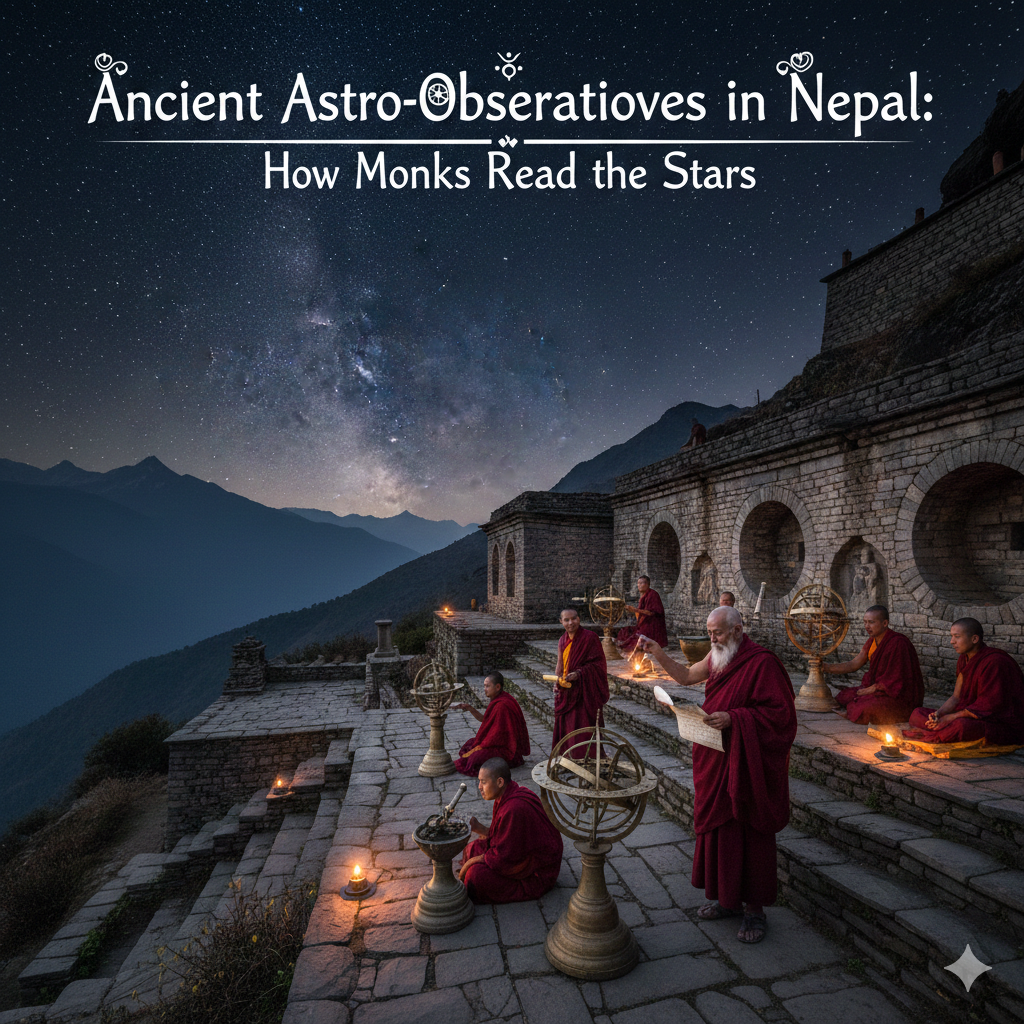
Ancient Astro-Observatories in Nepal: How Monks Read the Stars

High in the hills of Nepal, away from the neon glow of modern cities, lie ancient astro-observatories, silent structures perched on mountain ridges and monastery courtyards. These are not ruins; they are testaments to a time when the skies were the primary guides for calendars, rituals, and agricultural cycles.
For centuries, Buddhist monks studied the stars with meticulous care. Using simple tools carved from stone and brass, they charted the movement of the sun, moon, and planets, predicting festivals, eclipses, and the seasonal rhythms that governed both monastic life and local communities. Every constellation had meaning, every alignment a story, and every observation a connection between the human and the cosmic.
The Tools and Techniques
Monks relied on ingenious instruments like stone sundials, gnomons, and observatory platforms aligned with cardinal points. They measured shadows, recorded the movement of celestial bodies, and synchronized monastic rituals with cosmic events. Unlike Western observatories, these sites were as much spiritual centers as scientific ones: the act of observation was a meditation, a dialogue with the universe.
Some observatories were hidden within monastery courtyards, their platforms etched with concentric circles and aligned with solstices. Others, perched on ridge tops, offered unobstructed views of the Milky Way, allowing monks to follow celestial patterns across seasons.
Reading the Stars
To the monks, stars were not mere points of light—they were teachers, guides, and storytellers. By watching the skies, they could:
- Determine the most auspicious days for ceremonies and pilgrimages
- Track agricultural cycles and predict the best sowing periods
- Map the lunar calendar accurately, essential for Buddhist festivals
This knowledge was passed down orally and through hand-written manuscripts, often encoded with symbolism and art that blended astronomy, astrology, and spiritual philosophy.
Why These Observatories Matter
These astro-observers are unique intersections of science and spirituality. They reflect:
- A deep understanding of celestial mechanics without modern instruments
- The cultural importance of astronomy in daily life, religion, and agriculture
- The ingenuity of Himalayan communities who adapted knowledge to challenging environments
Visiting these sites today is not only a journey through space and time—it’s a window into a worldview where the stars guided human life, and observation was both devotion and discovery.
Conclusion
Nepal’s ancient astro-observatories stand as silent guardians of knowledge, bridging the gap between heaven and earth. Through the patient eyes of monks, the night sky was charted, festivals were timed, and communities thrived.
In these mountain sanctuaries, the stars are more than distant lights—they are a living guide, a teacher, and a timeless connection between humanity and the cosmos.
