
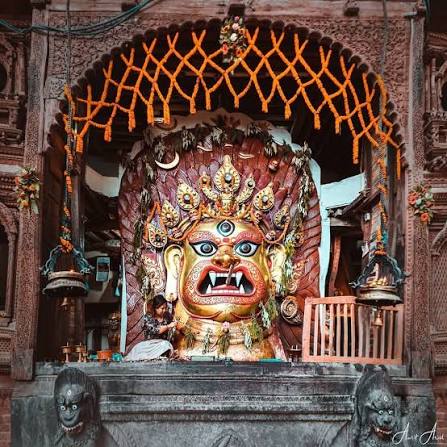

Yenya Punhi, the festival of Kathmandu, is more than a spectacular street celebration. It is a living record of the city's history, religion, community institutions, performing arts and relationship with the monsoon.
Every year, as the monsoon season begins to give way to autumn, the historic centre of Kathmandu changes.
The courtyards and squares around Hanuman Dhoka become gathering places. Traditional drums fill the streets. Masked dancers appear. Oil lamps illuminate old temples and palace courtyards. A huge ceremonial pole rises in Kathmandu Durbar Square. Chariots are pulled through the old city, and the Living Goddess Kumari makes one of her most important public appearances of the year.
This is Indra Jatra, known in the Newar language as Yenya or Yenya Punhi.

The historic squares of Kathmandu Valley become living theatres during Yenya Punhi.
For visitors, it can appear to be a colourful festival. For Kathmandu's communities, however, it is something much deeper. It brings together mythology, seasonal worship, ancestral remembrance, sacred performance, royal history, Newar community institutions, Buddhist and Hindu traditions, music, dance and the living urban heritage of Kathmandu.
The festival is also an example of how intangible cultural heritage survives not simply because it is displayed, but because communities continue to perform, organise, finance and transmit it.
What Is Indra Jatra?
Indra Jatra is an eight-day festival centred on the historic city of Kathmandu.
The festival honours Indra, the ancient Hindu and Vedic deity associated with rain and the heavens. It is traditionally connected with the end of the monsoon and the agricultural cycle, while the festival's many rituals incorporate a much wider collection of religious and cultural meanings.
The Nepal Tourism Board describes Indra Jatra as an eight-day festival of the Newar community of the Kathmandu Valley, featuring chariot processions, masked dances, religious enactments, illuminated temples and the public appearance of the Living Goddess Kumari.
But calling it simply a “festival of Indra” does not fully explain what visitors see. Indra Jatra is better understood as a complex festival system. Within the larger Yenya celebrations are the Indra-related rituals, the Kumari Jatra, Bhairava-related ceremonies, masked dances, processions, ancestor remembrance and numerous community rituals maintained by different traditional groups.
The Deep History of Indra Jatra
A History Older Than the Written Record
The history of Indra Jatra needs to be approached carefully.
Kathmandu's traditional historical narratives associate the festival with King Gunakamadeva, who is generally placed in the late 10th or early 11th century. Gunakamadeva is traditionally connected with the establishment and grand development of Kathmandu, purportedly laying out the city at the confluence of the Bagmati and Bishnumati rivers in the shape of Manjushree’s sword.
A scholarly discussion by Gérard Toffin notes that local tradition places the origins of Indra Jatra in the period of King Gunakamadeva, while the earliest documentary evidence currently known is a stone inscription from Bhaktapur dating to the 15th century. Another academic treatment similarly explains that the festival is traditionally attributed to Gunakamadeva but that documentary evidence appears later.
There is a profound difference between what communities remember and transmit as living tradition, and what surviving historical documents can directly establish. Both are vital to understanding living heritage.
The association with Gunakamadeva is particularly significant because Indra Jatra became deeply connected with Kathmandu's identity as a historic city. A Cambridge University Press history of Nepal connects Gunakamadeva with the initiation of Indra Jatra, relating the festival to older Indic traditions associated with Indra and the ceremonial Indradhvaja.
This suggests that Indra Jatra did not suddenly appear in its present form. Like many long-lived traditions, it developed through complex layers: older Indic religious ideas, Kathmandu Valley traditions, Newar ritual practices, royal patronage, urban community institutions, performing arts, and later additions associated with the Kumari tradition.
Video: Immersive cultural experiences documented by Mountain Tiger Nepal.
The Legend of Indra & The Sacred Pole
The most popular story associated with the festival tells of Indra coming down to the Kathmandu Valley in disguise.
According to traditional legend, Indra came to the valley looking for parijat flowers, associated with his mother. He was discovered while gathering the flowers and was captured by local people, who did not recognise him as the king of heaven. He was then tied to a ceremonial pole. His mother eventually came looking for him.
The story is one of the mythological explanations for the festival's rituals surrounding Indra, the ceremonial pole, and the relationship between the divine and human worlds. It is a religious and cultural tradition, representing part of the cultural memory through which communities understand the festival.
Yosin: The Sacred Pole
One of the most recognisable rituals of Indra Jatra is the raising of the Yosin, the ceremonial pole associated with Indra's flag. The raising of the pole marks the formal beginning of the major festival sequence.

The Kathmandu skyline, where the towering Yosin pole marks the beginning of the festivities.
The ritual is not simply a dramatic opening ceremony. The pole connects the physical city with the mythology of Indra and the traditional symbolic order of the festival. The eventual lowering of the pole marks the conclusion of the main festival cycle. The same basic visual sequence therefore gives the festival a beginning and an end: the pole rises, the city celebrates, the rituals unfold, and the pole is eventually lowered.
Kumari Jatra: The Living Goddess Appears
For many visitors, the most anticipated part of Indra Jatra is the appearance of Kumari, the Living Goddess of Kathmandu.
During the festival, the Kumari is carried through the historic streets on her ceremonial chariot. Two other chariots represent Ganesh and Bhairava. The procession moves through the old city, allowing devotees to receive a public glimpse and blessing.
The Nepal Tourism Board identifies the Kumari chariot procession as one of the central features of Indra Jatra, with the three chariots travelling through the historic streets of Kathmandu. The Kumari tradition also demonstrates how Indra Jatra is not a single religious tradition in isolation. The festival connects royal history, Hindu worship, Newar traditions and the sacred urban geography of Kathmandu.
Lakhey and the Masked Dances
Walk through Kathmandu during Indra Jatra and another world seems to emerge. Among the most recognisable figures is Lakhey, the powerful masked figure associated with traditional Newar performance. Masked dances involving deities, demons and other figures form a major part of the festival's visual and performative character.
The performances are not simply entertainment. They belong to a much older ritual performance tradition. The academic literature describes the festival as a combination of religious ritual, performance and urban social life, serving as an important setting for mask dance dramas including Mahakali Pyakhan, Pulu Kisi, Bhairava dances, and Lakhey dances.

The masks are part of a deep ritual vocabulary, transforming dancers into deities.
Why Guthi Matters to Indra Jatra
Perhaps one of the most important things to understand about Indra Jatra is that the festival does not survive simply because a government organises it once a year. It survives through community institutions.
One of the most important is the Guthi system. Guthis are traditional social and religious associations that have historically been responsible for maintaining temples, rituals, festivals, communal responsibilities and forms of cultural knowledge.
A major academic study by Monalisa Maharjan and Filipe Themudo Barata specifically used Yenya Punhi as a case study for examining how the Guthi system safeguards intangible cultural heritage. Their research found that the Guthi system remains an important reason for the continuity of Yenya Punhi and its associated rituals, despite pressures from modernisation.
Preserving Indra Jatra does not simply mean preserving costumes, masks, chariots or buildings. It also means preserving the social systems that make the rituals possible.
Documenting the Living History: A Modern Visual Approach
How do you preserve something that is inherently alive? A museum can preserve an object, and an archive can preserve a photograph. But a festival survives differently.
As we document this living heritage for future generations, capturing the essence of Indra Jatra visually demands a dynamic, multi-angle storytelling approach. To truly preserve its spirit, modern chroniclers must move fluidly—from the crisp, close-up mirrorless focus on the ancient, terrifyingly beautiful masks, to the rugged mobility of action cameras following the Lakhey as he weaves through narrow, crowded alleyways, all the way up to sweeping drone perspectives that frame the immense scale of the Yosin pole against the Kathmandu skyline.
How to Experience Indra Jatra Respectfully
For travellers coming to Nepal, Indra Jatra offers a different way to understand Kathmandu. If you are visiting Kathmandu during Indra Jatra, consider the festival as a cultural experience rather than a staged event.
- Arrive early when possible. Walk rather than relying on vehicles around the old city.
- Listen to the music and observe the different performances to understand the narrative.
- Respect barriers and procession routes. Avoid obstructing participants for photographs.
- Ask permission before photographing people closely, particularly performers or ritual participants.
- Remember that the most important people at the festival are not the spectators; they are the communities carrying the tradition forward.
Video: Exploring beyond the monuments with Mountain Tiger Nepal.
Experience Kathmandu Beyond the Monument
At Mountain Tiger Nepal, we believe that some of the most meaningful journeys begin when travellers look beyond the famous monument and ask a deeper question: How does this place live?
Indra Jatra provides one of Kathmandu's most remarkable answers. It is a festival of Indra. A celebration of the monsoon. A procession of the Kumari. A theatre of masks and music. A remembrance of ancestors. A legacy of kingship. A product of community institutions. And above all, a living tradition of Kathmandu.
Come to Kathmandu not only to see its heritage, but to experience it in motion.
Sources and Further Reading
- Nepal Tourism Board — Indra Jatra: Overview including the Yosin pole, Kumari procession, and Lakhey performances.
- Kathmandu Metropolitan City: Municipal calendars and reporting on the Yosin Thanegu ceremony.
- Gérard Toffin: “The Indra Jatra of Kathmandu as a Royal Festival: Past and Present” (Contributions to Nepalese Studies).
- Monalisa Maharjan & Filipe Themudo Barata: “The Kathmandu Valley's Indigenous Practices of Safeguarding Heritage”. Investigates Guthi, community participation and intangible cultural heritage.
- Michael C. Baltutis: The Festival of Indra: Innovation, Archaism, and Revival in a South Asian Performance (SUNY Press, 2023).
- UNESCO: Nepal Intangible Cultural Heritage Inventory (2026–2028 initiative).
