
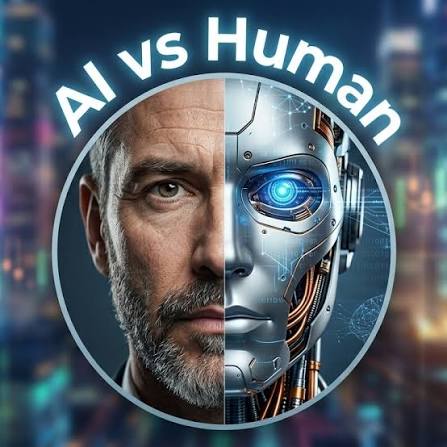
I Don't Want to Escape AI. I Just Don't Want to Become Dependent on It.
A personal thought on AI, human thinking, digital independence, and preparing for a future we cannot predict.
I use AI. A lot of us do.
It helps us write emails, understand complicated subjects, plan businesses, write code, create images, research ideas, translate languages, organize our thoughts, and sometimes even answer questions that we haven't been able to answer ourselves.
And honestly, that's incredible. We are living through one of the most interesting technological shifts in human history.
I don't mean this as an anti-AI argument. I'm not saying AI is evil, nor that it will destroy humanity. And I'm definitely not saying we should go back to living without technology.
I simply believe that no machine, company, product, algorithm, or technology should become so essential to our lives that we can no longer function without it. And that includes AI.
The Convenience Trap
There is something very interesting happening with AI. A few years ago, if I didn't know something, I would think about it. Then I would search for it. I might open a book, ask someone, try something, make a mistake, and try again.
Now? I can simply ask AI.
Maybe I just needed another five minutes. Maybe I needed to struggle with the problem. Maybe the act of searching for the answer was actually part of learning. Maybe the difficult part wasn't finding the answer—maybe the difficult part was learning how to think.
I Don't Want AI to Become My First Thought
This is probably the biggest change I want to make. I don't want to stop using AI. I want to change the order.
That small difference can completely change our relationship with technology. If I have a problem, I want to give myself a few minutes first. What do I already know? What do I think? What would I do if AI didn't exist? What information am I missing?
Then, if I still need help, I'll use AI. Not as my brain—as a tool for my brain.
What If AI Is Wrong?
AI is becoming remarkably capable, but capability isn't perfection. No machine is 100% efficient, no software is perfect, and no AI system is flawless.
AI can misunderstand a question, confidently provide incorrect information, inherit biases, change its behavior, or lose access to information. Platforms can shut down or policy shifts can occur.
If our entire knowledge system depends on a handful of companies, we are ultimately trusting those companies with an enormous amount of power. I hope they use it responsibly—but hope isn't a backup strategy.
I Want My Data to Remain Mine
This is where my thinking has started moving beyond AI itself. I want to build a personal offline archive. Not because I believe the internet is going to disappear tomorrow, but because I want to know that my important information exists somewhere that doesn't require a server, subscription, account, or internet connection.
- Important personal documents & work records
- Photos, videos, and personal creative projects
- Notes, research, and curated knowledge libraries
Digital independence isn't simply about privacy—it's also about continuity.
The 3-2-1 Rule: Three Copies, Not One
I've started thinking about personal data preservation in a simple way. One copy is not a backup.
And periodically, I check whether those backups actually work. Because a backup that has never been tested is just a comforting assumption. This isn't paranoia—it's basic resilience.
Local AI & Hybrid Resilience
Interestingly, I don't think the answer is to eliminate AI. In fact, I want to learn more about running local AI models directly on my own hardware without needing to send everything to a remote cloud server.
Instead of a binary choice between Cloud AI or No AI, I prefer a tiered mindset:
My New Personal Operating Rule
When facing a challenge, give myself a few minutes first. Think. Write. Search my own notes. Look at my books. Try something. Only then ask AI if I still need it.
And when asking AI, shift the prompt from "Tell me what to do" to "Here's what I think. Tell me where I'm wrong."
The AI-Free Day Experiment
Another experiment I'd like to adopt is having an occasional AI-free day. No ChatGPT. No AI search. No AI writing. No AI-generated solutions.
Just me, books, people, notes, research, software, and my own brain. Maybe I'll discover that I don't actually need AI as much as I think—or maybe I really do need it for certain tasks. Either way, I'll learn something about myself.
The Human Decision Log
I also want to start documenting important decisions. Not just the final answer, but the thinking behind it:
- What is the core problem?
- What do I currently believe?
- What options do I see, and what am I uncertain about?
- Did I use AI? What did it contribute versus what I decided?
Digital Independence for an Uncertain Future
Maybe the phrase I'm looking for isn't "escaping AI." Maybe it's digital independence. Being able to use tools while maintaining the ability to operate without them.
Perhaps the real challenge of the AI era isn't learning how to use AI—we've already started doing that. The bigger challenge might be learning when not to use it. When to think, read, write, ask another human, struggle, experiment, fail, and sit with a problem long enough for our own brain to produce an answer.
Use the machine. Learn from the machine. Build with the machine. But never forget how to be human without it.
