
Sky Burial Sites of the Himalayas: The Disappearing Practice of the "Bird Funeral"
When We Die, Where Do We Go
In the highest folds of the Himalayas, where life itself touches the clouds, the dead don't go underground; they rise, literally, to the sky.
Against the backdrop of peaks that wear snow as their armour and prayer flags snapping in thin air, an ancient ritual takes place that challenges everything we think we know about death, dignity, and letting go. Here, in villages that are high above the world, the departed take on their one last journey not into the earth's embrace, but into the beaks and stomachs of circling vultures. This is jhator (བྱ་གཏོར་), the sky burial practice so profound in its simplicity and so radical in its compassion that it stops the Western mind in its tracks.
Yet this sacred tradition, practised in the Himalayas for over a millennium, is quietly vanishing. Each year, fewer families choose the ancient way. Each year, the great birds of prey grow scarcer. What was once as natural as breathing in these high places now feels as fragile as morning mist, urging us to understand something extraordinary before it dissolves into memory.
Earth Meets the Sky
To understand sky burial is to understand the profound relationship between death and generosity that lies at the heart of Tibetan Buddhism. In these communities, where they reside amongst those in heaven, death is not an ending but a transformation. The body? Merely a temporary vessel for the journey of consciousness.
The practice springs from Buddhism's core teaching of anicca: impermanence. Everything changes, everything passes, and clinging to what was never truly ours only breeds suffering. When a person dies, their consciousness has already departed; what remains is simply matter, no different from the rocks and snow that form these mountains. To offer this matter to the vultures is considered the ultimate act of generosity, feeding lives with what can no longer sustain life.
But there's more to it than philosophy. In this mountainous landscape where wood is scarce, where the ground freezes solid for months at a time, and where every resource must be carefully conserved, sky burial makes practical sense. The vultures become partners in a cycle that wastes nothing, honors everything, and transforms death into sustenance for the living.
The ritual also reflects the Buddhist understanding of karma and merit. By offering their mortal remains to feed other beings, the deceased performs one final act of compassion. The family, by facilitating this gift, accumulates merit. Even in death, the web of interdependence that connects all life forms continues to weave itself.
Feeding the Sky
Dawn breaks cold over these high plateaus. The family has prepared through the night starting with prayers and mantras, burning juniper incense, preparing offerings of tsampa and butter tea. The body, wrapped in white cotton, has been kept in meditation posture, and lamas have performed the necessary rituals to guide the consciousness through the bardo, the intermediate state between death and rebirth.
The sky burial site is always chosen with care. Usually a high, isolated plateau where the winds are strong and the view extends endlessly across the mountain. In Tibet, places like Drigung Til Monastery and Sera Monastery have served as sacred grounds for centuries. But it's in Nepal's remote regions like Mustang, Dolpo, and the hidden valleys of the upper Himalayas where this practice persists most authentically, away from modern interference and curious eyes.
The rogyapas, the "body-breakers," arrive before sunrise. These men hold a sacred role in society, though one that sets them apart. They possess the spiritual fortitude and technical knowledge necessary to perform the ritual with both reverence and efficiency. Their work begins with prayers and offerings, acknowledging the sanctity of what they're about to do.
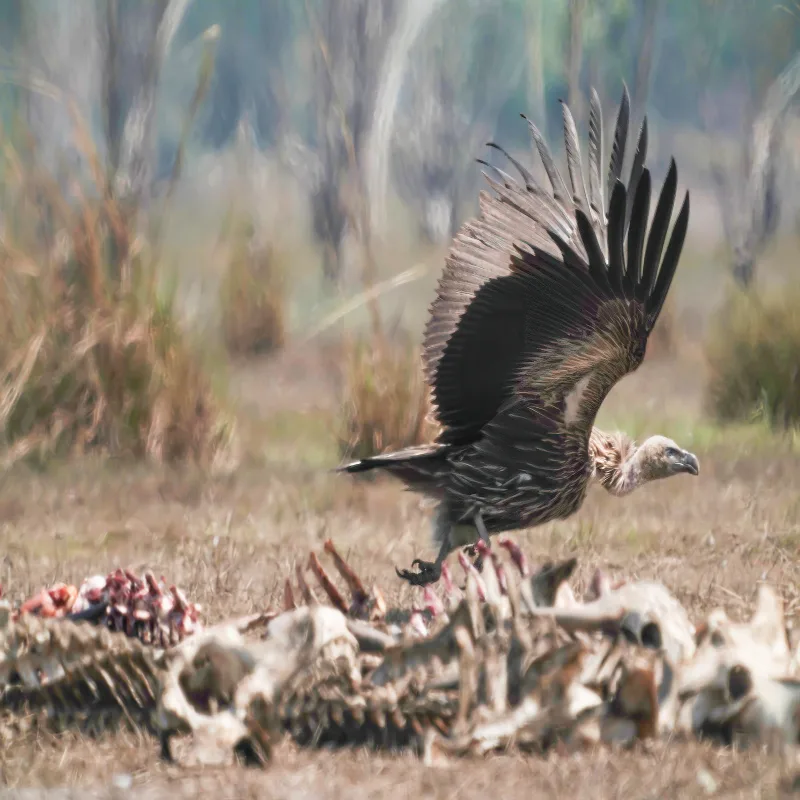
As the sun climbs higher, the preparation intensifies. The body is ceremonially disrobed and positioned on the flat stones that serve as the altar. Juniper branches are burned, their smoke carrying prayers skyward and signaling to the vultures, massive Himalayan griffons with wingspans reaching ten feet, that the offering is ready.
What follows unfolds what this ritual is all about. The vultures descend in circles, their shadows cross the stone platform like prayers were visible. The rogyapas work with precision, using traditional tools to prepare the body. Every motion is respectful, infused with mantras that honor both the deceased and the life form that will receive this final gift.
Within hours, nothing remains but prayer flags fluttering in the wind and the satisfied calls of birds returning to their roosts among the crags. The circle is complete. Matter has returned to matter, life has fed life, and the sky has accepted its offering with the same inevitability that it accepts the rising sun.
Tradition on the Edge
Yet this ancient practice teeters on the brink of disappearance, caught between the weight of modernity and the fragility of its own ecosystem. In Nepal, the high valleys of Mustang and Dolpo, with changing laws and shifting cultural attitudes have made the practice increasingly difficult to maintain.
Government regulations now require permits and oversight for sky burials, bureaucratizing what was once a purely spiritual act. Modern cremation facilities, accessible through improved roads and infrastructure, offer families what seems like a simpler alternative. Younger generations, educated in schools where Western values predominate, sometimes view their ancestral practices as primitive or embarrassing.
But perhaps most critically, the vultures themselves are vanishing. Nepal's vulture population has crashed by over 95% in recent decades, victims of veterinary drugs that prove toxic to scavenging birds. The massive griffons that once darkened the skies in their hundreds are now counted in dozens. Without the birds, the ritual cannot continue, and without the ritual another thread of human spiritual wisdom will be lost forever.
Conservation efforts struggle against overwhelming odds. Organizations like the Bird Conservation Nepal work tirelessly to establish vulture-safe zones and breed birds in captivity, but the scale of the decline is staggering. Climate change adds another layer of complexity, altering migration patterns and food sources. The great birds that served as psychopomps for countless generations are themselves now in need of guidance toward survival.
Even in Tibet, where the practice originated, political and social pressures have reduced sky burials to a fraction of their former frequency. What was once as natural as birth and marriage in Himalayan communities now requires special circumstances, particular permissions, and increasingly rare expertise.
Let Go of the Body, Hold Onto the Meaning
Standing at 4,000 meters above sea level, watching prayer flags snap in the thin air while contemplating the sky burial sites scattered across these impossible peaks, you begin to understand something profound about the relationship between life and death that modern society has largely forgotten.
In our world of preservation, embalming, and permanent monuments, we've made death static like a wall rather than a doorway. We spend enormous resources trying to make the temporary permanent, to preserve what was always meant to return to the elements. Our cemeteries sprawl across valuable land, our funeral industries consume forests worth of wood and metals, our grief becomes crystallized in granite and marble.
But here, in these wind-scoured heights, death is understood as the most natural thing in the world. The sky burial doesn't seek to preserve or memorialize the body, rather it seeks to transform it, to make it useful one final time, to demonstrate the ultimate teaching of non-attachment. The deceased literally gives their life to sustain other lives, completing a cycle that has no beginning and no end.
This perspective offers something profoundly healing to our death-phobic culture. It suggests that dying well doesn't mean clinging to what we're losing, but embracing what we're giving. It proposes that our final moments can be acts of service rather than battles against inevitability. It whispers that letting go completely might be the most generous thing we ever do.
The understanding of death as part of nature's flow, rather than an interruption of it, offers wisdom that extends far beyond funeral practices. It speaks to how we might live more fully by holding more lightly. Be it to our possessions, our roles, our very identities. If even our bodies are on loan, how much more so everything else we imagine we own?
Sacred, Not Spectacle
In our age of instant images and viral content, when the most sacred moments risk becoming mere entertainment, it's crucial to approach sky burial with the reverence it demands. This is not a tourist attraction, not a photo opportunity, not content for social media feeds. These are sacred rites of passage for communities shaped by centuries of spiritual philosophy, moments when families release their most beloved into the care of gods.
The danger of cultural voyeurism looms large in our interconnected world. Too often, spiritual practices from other cultures become exotic curiosities, stripped of their meaning and reduced to their most visually striking elements. The sky burial, with its setting and unfamiliar practices, is particularly vulnerable to this kind of misappropriation.
Tibetan Buddhist teacher Tenzin Wangyal Rinpoche once wrote,
"Compassion is not a relationship between the healer and the wounded. It's a relationship between equals. Only when we know our own darkness well can we be present with the darkness of others."
This wisdom applies directly to how we should approach traditions that challenge our assumptions about death and dignity.
The sky burial comes from a worldview that sees death as liberation, the body as a gift, and the vultures as blessed beings performing a sacred service. To witness or learn about this practice without understanding its spiritual context is to miss its essence entirely. Worse, it risks turning profound spiritual teachings into mere spectacle.
For those who find themselves in regions where sky burial is still practiced: trekking through Dolpo or exploring the hidden valleys of Mustang, never ask to witness a burial. Never photograph without explicit permission and understand that in most cases, the most respectful response is silence and distance. Support local communities through ethical trekking while understanding and respecting traditional practices.
The goal is not to see everything, but to understand something. Not to capture images, but to be changed by ideas. Not to take home souvenirs of the exotic, but to carry forward wisdom about what it means to live and die with dignity in a world where both are increasingly commodified.
Between Heaven and Earth
As the sun sets behind the great peaks of the Himalayas, painting the summits in hues of rose and gold, you begin to understand why sky burial belongs to this landscape and no other. These mountains that stretch toward infinity, these skies that seem to hold the entire universe, these winds that carry prayers across impossible distances form the perfect cathedral for a practice that recognizes no separation between earth and heaven, between body and spirit, between ending and beginning they truly are the honoured one.
In these high places, even death is a gift, not a taking away, but a giving back. The sky burial sites remind us that everything we are is borrowed, everything we have is temporary, and everything we do can be transformed into an offering.
The practice may be disappearing, but its wisdom remains as relevant as ever. In a world struggling with questions of sustainability, meaning, and our relationship with the natural world, the sky burial offers profound answers. It shows us what it looks like to live in complete harmony with natural cycles, to treat death as a sacred responsibility rather than a medical event, and to make our final act one of service rather than preservation.
Perhaps we cannot all offer our bodies to the vultures when our time comes. But we can learn to hold more lightly to what we imagine we possess. We can practice the art of letting go while we still have breath to do so consciously. We can recognize that in a world of finite resources and infinite needs, generosity even in death might be the most revolutionary act of all.
The great birds still circle these peaks, though fewer now than before. The prayer flags still flutter in the thin air, carrying their mantras across the roof of the world. And somewhere in the hidden valleys of Nepal and Tibet, families still gather to perform humanity's most radical act of love. Releasing their beloved completely, trusting in the wisdom of impermanence, feeding the sky with what has left the earth.
In the end, that may be the most important lesson the sky burial teaches: that between heaven and earth, between life and death, between holding on and letting go, there is a third way which is the way of the gift, the way of trust, the way of understanding that what appears to be an ending is always, somehow, a new beginning.
