
The Great Himalaya Trail: Trekking Across the Roof of the World
The Great Himalaya Trail (GHT) is not just a trekking route; it’s a journey through the heart of the world’s most dramatic mountain landscapes. Stretching from eastern Nepal to the westernmost regions and spanning across the Greater Himalayas including Nepal, Bhutan, India, and Tibet the trail represents the ultimate adventure for intrepid explorers. While a fully continuous route is still largely conceptual, the GHT promises to be the longest and highest alpine trek in the world, covering more than 4,500 km in its full vision.
From the towering peaks of Kanchenjunga to the remote plateaus of Humla, the trail showcases an extraordinary diversity of mountains, cultures, wildlife, and ecosystems.

A Journey Through Nepal’s Hidden Gems
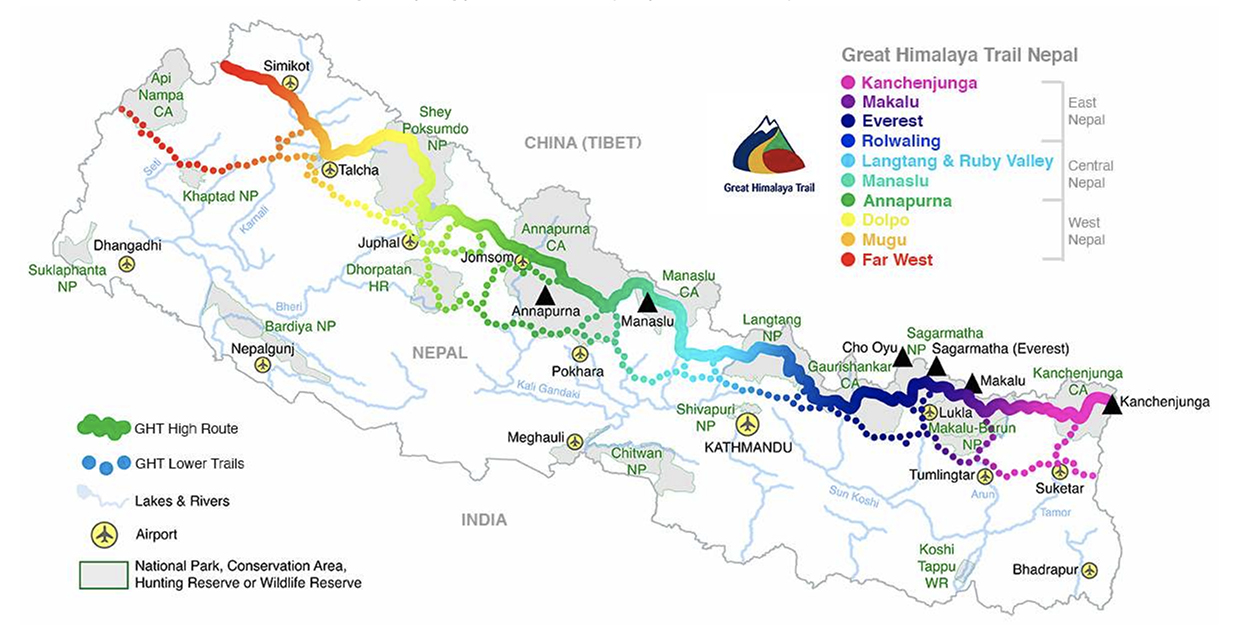
Nepal’s segment of the GHT offers a rare combination of natural beauty and cultural richness. Crossing 16 districts, the trail stretches from Dolpa in the north, near the Tibetan plateau, to Darchula in the west, bordering India. While popular trekking routes like Everest, Annapurna, and Langtang attract thousands of trekkers, the GHT guides travelers to remote and lesser-known regions, providing authentic experiences in isolated communities where life has remained largely unchanged for centuries.
Key Highlights Along the GHT in Nepal:
- Kanchenjunga: The world’s third-highest peak at 8,586 m, surrounded by diverse flora and indigenous communities like the Rai and Limbu.
- Makalu Barun: Home to more than 3,000 species of flowering plants, including rhododendrons and orchids, and dominated by Mt. Makalu (8,463 m).
- Everest and Rolwaling Himal: Experience the Khumbu region with Sherpa culture, stunning high peaks, and wildlife including red pandas and leopards.
- Rara and Jumla: Trekking through high-altitude passes like Daphe Lekh (4,500 m), remote villages, and fertile farmlands, eventually reaching the serene Rara Lake.
Two Ways to Conquer the Trail: High Route vs Low Route
The GHT offers two distinct trekking experiences, depending on your level of adventure and fitness:
1. High Route (Extreme Adventure)
- Distance: ~1,700 km
- Duration: Approx. 150 days
- Altitude: Up to 6,146 m
- Experience: This route takes you through high-altitude landscapes, glaciers, and rugged terrain. Trekkers navigate remote villages untouched by tourism, requiring strong physical fitness and specialized mountaineering equipment.
- Challenge: Only for experienced adventurers, often accompanied by a local guide for safety at extreme altitudes.
2. Low Route (Cultural Exploration)
- Distance: ~1,500 km
- Duration: Approx. 100 days
- Altitude: Average 2,000 m, with passes up to 4,519 m (Jang La)
- Experience: Explore mid-hill regions, forests, pastures, rice terraces, and thriving villages. Perfect for trekkers seeking Nepal’s rich culture, heritage, and natural diversity.
- Accessibility: More suitable for moderate trekkers; offers insight into the lifestyles of various ethnic communities.
The GHT Beyond Nepal
While Nepal hosts the heart of the GHT, the trail also extends across Bhutan, Tibet, and India, connecting extraordinary landscapes and cultural experiences:
- Bhutan: Trekkers begin in Paro, traverse the Jhomolhari Trek, pass high lakes, and explore the Snowman Trek, a 40-day adventure through remote valleys.
- Tibet: Offers access to Namche Barwa, sacred monasteries, and panoramic Himalayan vistas.
- India & Pakistan: Proposed extensions aim to include Nanga Parbat and other iconic peaks along the Greater Himalayas.
Adventure on Wheels: GHT on Bikes
The GHT is not just for hikers. Mangal Krishna Lama, a Nepali adventurer, became the first to complete the upper route on a mountain bike, covering over 90,000 m of elevation gain and crossing 22 high passes above 5,000 m in 88 days. This feat highlights the trail’s versatility and extreme challenge, while also promoting tourism, education, and local economic development in remote communities.
Why the GHT Is a Once-in-a-Lifetime Trek
- Unparalleled Scenic Diversity: From subtropical forests to alpine meadows, glaciers, and rugged peaks.
- Cultural Immersion: Encounter Sherpas, Thamis, Gurungs, Limbus, and Bön Buddhist communities.
- Biodiversity: Spot elusive wildlife like snow leopards, red pandas, and Himalayan black bears.
- Remote Adventure: Experience parts of the Himalayas untouched by mass tourism.
- Personal Challenge: Push your physical and mental limits on a journey spanning hundreds of kilometers.
Planning Your GHT Adventure
- Time Commitment: High Route ~150 days, Low Route ~100 days. Shorter sections are possible for trekkers with limited time.
- Preparation: Proper gear, physical fitness, and acclimatization are essential for high-altitude sections.
- Guides and Logistics: Hiring experienced local guides ensures safety, permits, and cultural insight.
- Best Seasons: Spring (March–May) and Autumn (September–November) offer the clearest views and favorable weather.
Final Thoughts
The Great Himalaya Trail is not just a trek; it is an odyssey across some of the most remote, pristine, and culturally rich landscapes on Earth. Whether you choose the high route for extreme adventure, the low route for cultural exploration, or even GHT on Wheels for an adrenaline-fueled mountain biking expedition, the trail promises a life-changing Himalayan experience.
For those seeking epic vistas, rich culture, and the ultimate adventure, the GHT is the definitive Himalayan journey the adventure of a lifetime awaits across the Roof of the World.
