
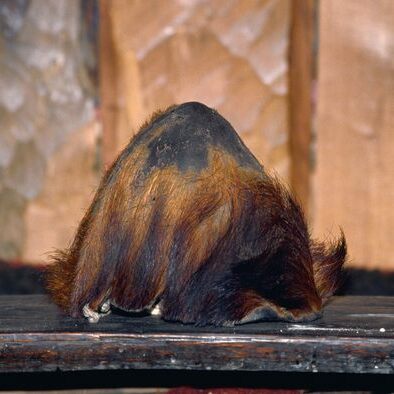
The Yeti Scalp of Khumjung
In Nepal's Khumbu Region, at 3,790 meters (12,400 feet), the village of Khumjung houses a small Buddhist monastery. Within it lies a famous cryptozoological artifact: a purported Yeti scalp, which Sir Edmund Hillary, one of the first people to summit Mount Everest alongside Tenzing Norgay Sherpa, took on a world tour in 1960.
The half football-shaped object sits today in a padlocked glass box at the village gumba. For over 200 years, this venerated object has been kept at the monastery in Khumjung, drawing pilgrims and curious trekkers who pay a few rupees as offering to glimpse what villagers believe is proof of the Himalayas' most elusive inhabitant.
The World Book Expedition
Hillary organized the 1960-61 Silver Hut expedition, which combined serious high-altitude physiological research with a search for the fabled abominable snowman. The expedition, sponsored by World Book Encyclopedia and conducted in partnership with scientific institutions, established a research station at 5,790 meters (19,000 feet) where team members lived for six months studying human adaptation to extreme altitude.
Hillary had been somewhat of a believer in the 1950s but approached the Yeti search scientifically, stating "We shouldn't go just Yeti searching, we should study how people live at high altitude". The scientific program proved groundbreaking, with researchers demonstrating that Mount Everest could be climbed without supplemental oxygen after proper acclimatization.
But it was the cryptozoological component that captured public imagination. Hillary and journalist Desmond Doig interviewed Sherpa communities, documented footprints, and collected physical evidence. Their most significant find came in Khumjung village, where they discovered the monastery's prized possession: the Yeti scalp.
The Bargain
The scalp belonged to an elderly Khumjung woman who considered it a protective charm for the entire village. Removing such a sacred object required delicate negotiation. Hillary struck a deal with the community: he would donate funds for the monastery and local school, and the scalp would travel with a guardian monk to ensure its spiritual protection.
Konchok Chumbi was chosen as custodian of the Yeti scalp, and he accompanied Hillary and the specimen to Japan, USA, UK and Europe. The monk's presence served both practical and spiritual purposes, reassuring villagers that their relic would return safely while providing Western scientists access to local knowledge about the supposed creature.
Scientific Scrutiny
Hillary and Doig took the scalp to Chicago in December 1960, where it underwent extensive examination by zoologists and other experts. The specimen presented puzzling characteristics that initially intrigued researchers. Hillary noted the scalp's unusual features, describing it as "shaped like a Tibetan priest's cap, rather like a crown that has a ridge of hair on the top of it".
However, upon examining the scalp, zoologist Marlin Perkins concluded that it could not be scalp tissue. Further analysis revealed the truth: the scalp had been fashioned from the hide of an animal, most likely a goat-antelope native to the Himalayas, specifically a serow.
The scientific verdict was clear, but the story didn't end with debunking. The expedition's broader Yeti investigation found no compelling evidence for the creature's existence. Footprints and tracks were proven to be from other causes, and no physical specimens withstood scientific scrutiny.
Cultural Perspective
The scientific dismissal didn't diminish the scalp's significance for the people of Khumjung. When Konchok Chumbi returned with Hillary to the village, he offered a perspective that highlighted the cultural divide between Western skepticism and Himalayan tradition. The monk told the Guardian newspaper, "We don't believe in giraffes and lions in Nepal because there aren't any there. Likewise, you don't believe in Yetis because you have none in your country".
This observation cuts to the heart of cryptozoology's central tension: the difference between cultural knowledge and scientific evidence. For Sherpa communities, the Yeti represents something more than a biological entity; it embodies the wild, the spirit of the Himalayas.
Legacy and Modern Context
The Khumjung scalp returned safely to its monastery, where it continues to attract visitors from around the world. A duplicate scalp exists at New York's Explorer's Club, serving as a reminder of the expedition's global scope and the era's fascination with cryptozoological discoveries.
Hillary's 1960 expedition marked a turning point in Yeti research. Rather than encouraging further speculation, the rigorous scientific approach effectively closed the chapter on serious cryptozoological investigation of the creature. The scientific programme was an unqualified success, and the expedition became one of the classic studies in high-altitude physiology.
Today, the scalp serves multiple roles: tourist attraction, cultural artifact, and scientific footnote. A moment when science intersected with a legend, when the world's most famous mountaineer applied rigorous methodology to humanity's enduring fascination with the unknown.
The Yeti scalp of Khumjung is still locked in its glass case, neither fully sacred relic nor completely debunked curiosity. Instead, it occupies the liminal space between belief and evidence, reminding us that some mysteries matter more for the questions they raise than the answers they provide. In the Himalayas' thin air, the boundary between earth and sky blurs, similar to the line between myth and reality, perhaps that's exactly where such objects belong.
