Australia Has a Different Relationship With the Sun
Spend enough time in Australia and one thing becomes difficult to miss: people talk about the sun differently.
At beaches, schools, sporting grounds, workplaces and outdoor events, advice about sunscreen, hats, shade and UV exposure has become part of everyday life.
The conversation is not simply about avoiding a sunburn after a day at the beach. It is about understanding something that cannot be seen, cannot be felt and does not always behave in the way our senses tell us it should.
That something is ultraviolet radiation — UV.
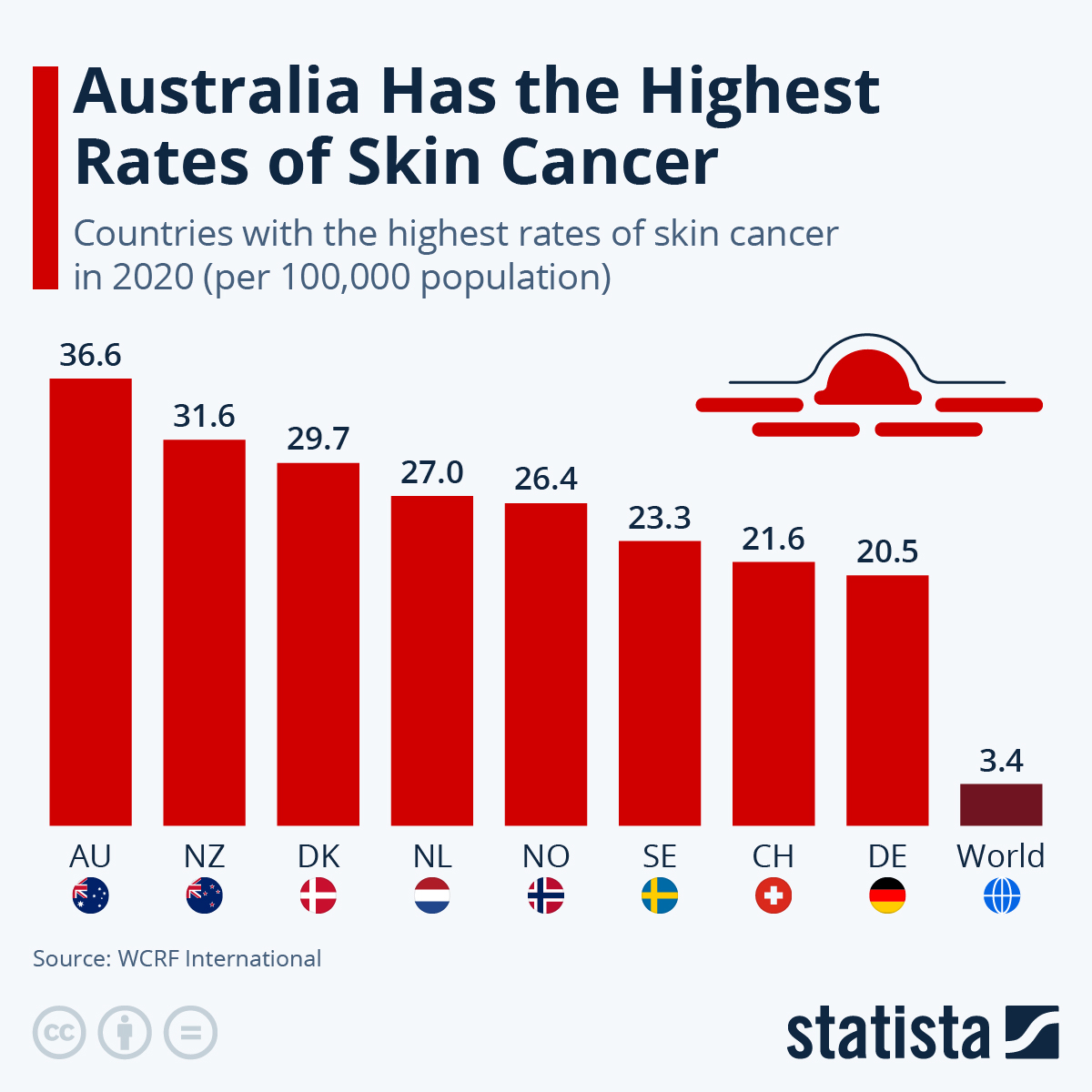
Key Insight: Australia has one of the highest rates of skin cancer in the world. Cancer Council Australia reports that around 2 in 3 Australians will be diagnosed with some form of skin cancer before the age of 70. More than 95% of skin cancers are directly attributed to exposure to UV radiation.
Those numbers help explain why sun protection has become so deeply embedded in Australian culture.
Source: Cancer Council Australia — Skin cancer: cause, symptoms and risks — Updated 30 July 2026 — Official source
The Australian Conversation Did Not Begin With Sunscreen
Australia's modern sun-safety culture developed over decades. One of the most recognisable public-health campaigns was the Slip, Slop, Slap campaign, which encouraged Australians to slip on protective clothing, slop on sunscreen and slap on a hat.
The message eventually evolved into the familiar five-part SunSmart approach:
Clothing can be one of the most straightforward ways of reducing direct UV exposure. Longer sleeves and longer garments can provide more coverage than exposed skin. For outdoor activities, clothing designed specifically for sun protection can provide another useful layer.
Use an appropriate broad-spectrum sunscreen on exposed skin. Application matters, as does reapplication according to the product instructions — particularly after swimming, sweating or towel-drying.
The head, face, ears and neck are frequently exposed. A broad-brimmed hat can provide more coverage than a standard cap.
Shade can reduce direct exposure. It is particularly useful when combined with clothing, a hat and sunscreen. Shade, however, is not necessarily an absolute UV barrier because reflected and scattered radiation can still reach exposed areas.
The eyes are also exposed to UV radiation. Appropriate UV-protective sunglasses can form part of a complete sun-protection approach.
What makes the Australian approach interesting is that it does not suggest that people should stop enjoying outdoor life. Instead, it treats sun protection as part of being outdoors.
That distinction is important for travellers too. The question is not necessarily: “Should I go outside?” It is: “How do I understand the environment I am entering?”
Source: Cancer Council Australia — Be SunSmart / Sun protection — Official source
What Actually Causes the Damage?
The phrase “sun damage” can be misleading. The sun produces several forms of energy:
Visible Light
This is the sunlight we can see with our eyes.
Infrared Radiation
This contributes strongly to the sensation of warmth we feel.
Ultraviolet Radiation
We cannot see it. We cannot feel it. Yet excessive UV causes sunburn, skin cell damage, premature ageing and skin cancer.
This is one of the most important concepts in understanding sun safety: Our senses are not good UV detectors.
A person can feel comfortable while being exposed to significant UV radiation. A cool breeze does not tell you that UV is low. A cloudy sky does not automatically tell you that UV is low. And the temperature on the weather forecast is not a substitute for the UV Index.
Sources: Cancer Council Australia & World Health Organization
The UV Index: A Better Question Than “Is It Hot?”
Cancer Council Australia divides the index into five categories and advises Australians to use sun protection when the UV Index reaches 3 or above:
| UV Index |
Category Level |
Sun Protection Recommended? |
| 1 – 2 |
Low |
Minimal protection required for short exposure |
| 3 – 5 |
Moderate |
Yes — Apply SunSmart measures |
| 6 – 7 |
High |
Yes — Comprehensive protection required |
| 8 – 10 |
Very High |
Yes — Avoid full exposure during peak hours |
| 11+ |
Extreme |
Yes — Maximum protective measures mandatory |
The Cloud Problem
Clouds make the subject even more confusing. People naturally associate clouds with weaker sunlight. And cloud cover can reduce UV exposure — but it does not necessarily eliminate it.
Light or thin cloud can allow considerable UV to pass through, meaning that a day that looks dull or feels cool may still produce significant UV exposure.
Source: Cancer Council Australia & WHO (21 June 2022)
This is Where Australia and the Himalayas Unexpectedly Meet
Australia's sun-safety conversation may have been shaped by beaches, outdoor sport and an exceptionally strong public-health response to skin cancer.
The Himalayas introduce a completely different visual world. But the underlying science does not change:
- UV remains invisible.
- Temperature remains an unreliable measure of radiation.
- Altitude increases intensity drastically.
- Reflection from fresh snow can almost double total exposure.
The environment is different. The physics is not. That is the bridge between an Australian beach and a Himalayan trail.
Company Spotlight
About Mountain Tiger Nepal
For travellers exploring the world's most dramatic high-altitude landscapes, understanding the environment is as crucial as taking the first step on the trail.
Mountain Tiger Nepal is a premier destination management and adventure travel specialist based in Kathmandu, Nepal. Established with a vision to deliver authentic, safety-conscious, and deeply immersive Himalayan journeys, we specialize in high-altitude trekking, peak climbing expeditions, cultural wilderness tours, and tailored mountain adventures across Nepal, Tibet, and Bhutan.
Safety & Expertise
Experienced veteran Sherpa guides trained in high-altitude safety, weather assessment, and medical protocols.
Tailored Expeditions
Custom itineraries across Everest, Annapurna, Manaslu, Langtang, Mustang, and off-the-beaten-path trails.
Responsible Travel
Committed to ethical porter treatment, environmental stewardship, and supporting local mountain communities.
The Traveller's Mindset Shift
Understanding the environment allows travellers to experience the Himalayas more intelligently without sacrificing the thrill of adventure. Consider how simple questions shift perspective:
-
Instead of: “Will it be cold today?”
Ask: “What will the UV conditions be at this elevation?”
-
Instead of: “Will it be cloudy?”
Ask: “How much protection will I need for a 6-hour trek above the treeline?”
-
Instead of: “I am wearing warm clothing, so am I protected?”
Ask: “Which parts of my face, lips, neck, and hands remain exposed?”
-
Instead of: “It doesn't feel hot.”
Ask: “What does the UV Index say?”
Next in the Series
Understanding UV Exposure at High Altitude
From Australian sun safety to the high Himalayas: how altitude, reflection, snow, cloud, latitude and long days outdoors change the UV environment. The next article will take the science introduced here and move it directly onto the mountain pass.
Medical Note: This article is an educational resource about ultraviolet radiation and outdoor travel. It is not medical advice and does not replace advice from a qualified medical professional. Individual skin-cancer risk varies according to factors including previous UV exposure, skin type, family history and other circumstances. Anyone concerned about a skin lesion, unusual change or personal skin-cancer risk should consult an appropriate healthcare professional.
Sources & Further Reading