
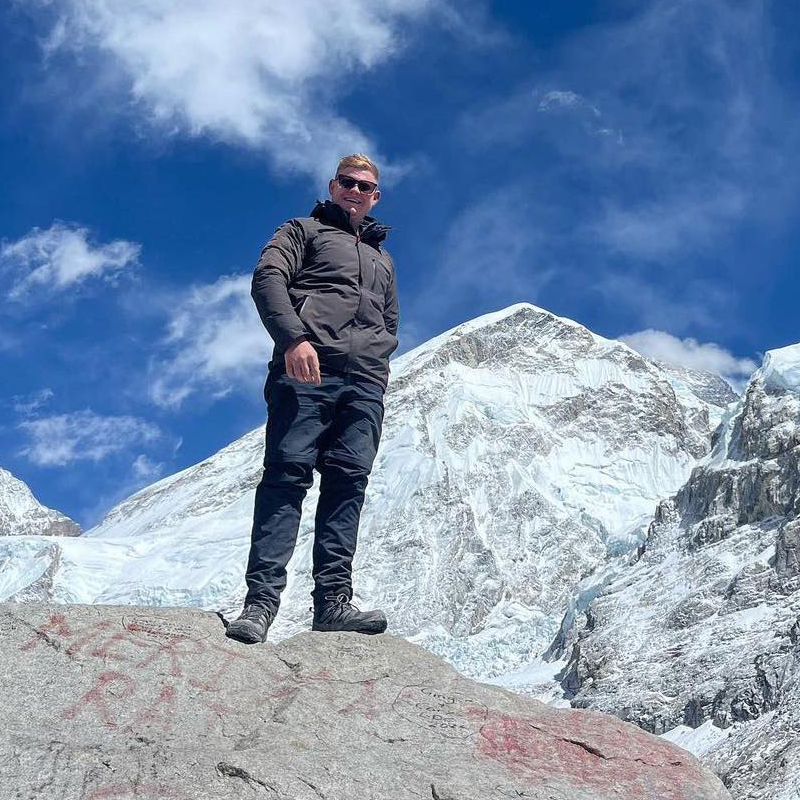
Does Altitude Increase UV Exposure? What Hikers and Travellers Should Know
A mountain morning can feel completely different from a day at the beach. Cold air and light breeze can hide an environment with significantly higher ultraviolet radiation.

A mountain morning can feel completely different from a day at the beach.
The air may be cold. A breeze may be blowing. You may even be wearing a jacket and walking through clouds.
Yet your skin can still be receiving significant ultraviolet (UV) radiation.
That is one of the most important things travellers, hikers and trekkers need to understand about spending time at higher elevations: temperature and UV exposure are not the same thing.

UV Radiation vs Heat: Why Cool Days Can Still Cause Sun Damage
In our previous article, we explored why a cool day should not automatically be considered a low-UV day. UV radiation is invisible and cannot be felt like heat.
Read Series 2 Article →Now take that idea into the mountains.
As elevation increases, the atmosphere above you becomes thinner. There is less atmosphere available to absorb and scatter some of the sun's UV radiation. At the same time, mountain surfaces can reflect UV back toward you.
The result is an environment where a traveller may be surrounded by cold air while still receiving substantial UV exposure.
And this becomes particularly relevant in the Himalayas.
1. What Happens to UV as Altitude Increases?
Yes — UV radiation generally increases with altitude.
The reason is relatively straightforward.
Before sunlight reaches your skin, it travels through the Earth's atmosphere. The atmosphere, including ozone and other components, absorbs and scatters some of that radiation.
At higher elevations, there is less atmosphere above you.
The World Health Organization explains that UV radiation increases with altitude because thinner air means less UV radiation is absorbed before reaching the Earth's surface.
The exact increase is not identical everywhere. It varies according to factors such as latitude, season, solar elevation, ozone, atmospheric conditions and surface reflection.
This is important because altitude should not be treated as a simple formula such as: “Higher mountain = exactly X% more UV.”
The reality is more complex.
But the overall relationship is clear:
As you climb higher, UV exposure can become an increasingly important part of your outdoor environment.
2. Why Can Mountains Feel Cold but Still Have Strong UV?
This is where many travellers get caught out.
Your body can feel temperature. It cannot feel UV radiation.
Heat is associated primarily with infrared radiation and other atmospheric and environmental factors. UV is a different part of the electromagnetic spectrum.
That means cold does not mean low UV.
A high-altitude trail can feature:
- Cold air
- Strong wind
- Snow or ice
- Cloudy periods
- Low temperatures
- Intense sunlight when the clouds clear
All at the exact same time.
Cancer Council Australia similarly explains that UV is separate from the heat we feel and can remain high on cool or overcast days.
This is why mountain travellers should avoid using temperature as their sun-protection guide. Instead, think in terms of:
UV Index + altitude + exposure time + surroundings.
3. The Thin-Atmosphere Effect
The atmosphere acts as part of Earth's natural protection system.
As sunlight passes through it, some UV radiation is absorbed and scattered.
At altitude, there is simply less atmospheric mass above you.
The World Health Organization estimates that UV levels increase by approximately 10% for every 1,000 metres of altitude as a broad rule of thumb, although actual conditions can vary considerably.
Other research has found different altitude effects depending on wavelength, season, atmospheric conditions and location.
So the practical lesson for hikers is not to calculate UV exposure mathematically while walking. It is much simpler:
Higher elevation deserves more attention to UV protection.
And in a place like the Himalayas, where trekking routes can rise from relatively low valleys to elevations above 4,000 or even 5,000 metres, that environmental change can be substantial.
4. Snow and Water Can Change the Equation
Altitude is only part of the story. The surface around you matters too.
Some mountain environments contain highly reflective surfaces such as:
- Fresh snow
- Ice
- Glaciers
- Wet surfaces
- Water
These surfaces can reflect UV radiation and contribute to the amount reaching exposed skin and eyes.
Cancer Council Australia notes that snow and water are among the important UV-reflective surfaces, with snow capable of reflecting a particularly large proportion of UV.
The World Health Organization also highlights fresh snow as a particularly strong reflector and warns that reflection needs to be considered when assessing UV exposure.
You may be receiving UV: from above + through atmospheric scattering + from the surrounding surface.
That reflected component is particularly important for the eyes. This is one reason proper sunglasses or protective eyewear are not simply an accessory for a snowy Himalayan trek. They are part of responsible mountain preparation.
5. Exposed Trails Mean More Direct Exposure
Mountain landscapes are not all the same.
A forest trail can provide natural shade. A narrow valley may limit direct exposure at certain times. But many high-altitude trekking sections are remarkably open.
Imagine walking across:
- A rocky ridge
- An exposed hillside
- A high mountain pass
- A glacier approach
- A broad alpine valley
- A snow-covered trail
There may be very little natural shade. And unlike an urban environment, there may be nowhere to step indoors for an hour.
This is why duration matters. A traveller spending six or seven hours outdoors on a trekking day is experiencing a very different exposure pattern from someone walking between buildings for twenty minutes.
6. What About Clouds and Mountain Weather?
Clouds make mountain weather particularly deceptive.
A cloudy day can look like a low-sun day. But UV does not always disappear simply because the sky is covered.
The World Health Organization notes that UV can remain significant through cloud cover, particularly when clouds are thin or broken. Cancer Council Australia likewise warns that solar UV can pass through light clouds and that cloudy conditions should not automatically be interpreted as safe conditions.
Mountain weather can change rapidly. You might begin your morning under cloud, walk for several hours, and suddenly emerge into intense sunlight above the cloud layer.
So rather than asking: “Is it sunny?”
A better question is: “What is the UV Index, and how long will I be outside?”
7. Why Trekkers Can Easily Underestimate UV Exposure
Mountain travellers often prepare extremely carefully for cold. They think about:
- Thermal layers & down jackets
- Gloves & trekking boots
- Sleeping bags & waterproof shells
- Altitude sickness & hydration
These are all important. But sun protection can sometimes receive much less attention.
There is a psychological reason for this: people associate sun exposure with heat.
A hot beach immediately communicates: “I am in the sun.”
A cold Himalayan trail communicates: “I need another layer.”
A jacket may protect much of your body, but it does not necessarily protect your face, nose, ears, lips, neck, hands, exposed wrists, or the area around your eyes — exactly the areas that remain exposed for hours.
8. Your Face, Lips, Ears, Neck and Hands Need Attention
9. Sun Protection for Hikers
Good mountain sun protection does not need to be complicated. It needs to be consistent.
- Cover up: Long sleeves, trekking trousers, and suitable neck coverage reduce UV reaching skin.
- Use broad-spectrum sunscreen: Cancer Council Australia recommends SPF 50+ broad-spectrum, water-resistant sunscreen applied to exposed areas before setting out.
- Protect your head: A suitable wide-brim hat or trekking head covering shades face, ears, and neck.
- Protect your eyes: Wear UV-protective category 3 or 4 sunglasses suitable for mountain conditions.
- Use shade whenever practical: Reduces direct exposure during breaks.
- Check the UV Index: Cancer Council Australia recommends protection when the UV Index reaches 3 or above.
10. What Does This Mean in the Himalayas?
Research specifically examining UV radiation in the Nepal Himalayas has looked at locations between approximately 2,735 and 4,355 metres above sea level. The study identified enhanced UV exposure for climbers and mountaineers because of the combined effects of increasing altitude and reflection from snow and ice.
More recent research comparing UV conditions across Nepal also found a clear relationship between higher elevations and stronger UV exposure, with locations such as Lukla showing a greater prevalence of high, very high and extreme UV conditions than lower-elevation locations.
A Mountain Does Not Have to Feel Hot to Affect Your Skin
Cold air does not cancel UV. Clouds do not guarantee low UV. Higher altitude can increase UV exposure. Snow and ice can reflect UV. And a long trekking day can create significant cumulative exposure even when you never feel hot.
What Should a Trekker Actually Remember?
- Check the UV Index: Temperature is not a reliable indicator.
- Cover exposed skin: Clothing provides continuous protection while walking.
- Use sunscreen properly: Pay attention to face, ears, neck, and hands.
- Protect your eyes: Essential around snow, ice, and high reflection.
- Think about duration: Hours outdoors requires proactive protection.

Why Australia Talks About Skin Cancer, UV & Sun Exposure
Learn why Australia has led global sun-safety awareness and how lessons from the coast apply directly to mountain travel environments.
Read Article →Mountain Tiger Nepal approaches trekking as more than a route between two points. Understanding the environment — including weather, altitude, terrain and sun exposure — is part of preparing for a better mountain experience.
